
The AC Mismatch
Why Artificial Cooling is the Silent Catalyst for Barrier Decay
In Pakistan’s urban centers—Karachi, Lahore, Islamabad—the air conditioner is a non-negotiable luxury. However, for your skin, it represents a brutal physiological challenge known as the AC Mismatch. This phenomenon is a primary driver of the “cranky,” sensitive skin we see in modern professional environments.
Key Take-Away
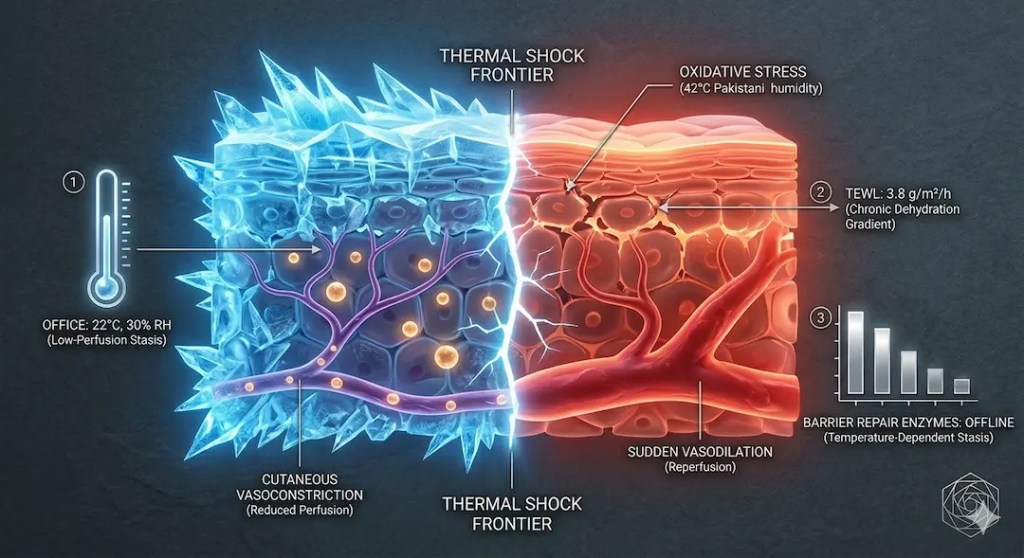
Constant transitions between extreme heat (42°C) and AC (22°C) cause your skin to “hibernate,” slowing down its repair enzymes and dehydrating the tissue through severe Transepidermal Water Loss (TEWL).
Protect your skin before entering the AC – Apply a specialized Occlusive Recovery layer to trap moisture and actively support the delivery of vital nutrients during perfusion stasis.
The Real Threat
The “Ischemic-Reperfusion” Cycle
The most damage happens when you leave the office. Re-entering the heat causes sudden Vasodilation (vessels expanding). This rapid fluctuation creates oxidative stress and micro-tears in the lipid matrix.
The Thermal Shock
When you step from 42°C humidity into a 22°C office, your body undergoes an immediate “Thermal Shock” (Sympathetic Vasoconstriction). To conserve core heat, your nervous system triggers Cutaneous Vasoconstriction. • Reduced Perfusion: Your blood vessels shrink, diverting blood away from the skin’s surface. While this prevents heat loss, it also stops the delivery of vital nutrients and oxygen to the epidermis. • Enzyme Stasis: Barrier repair enzymes are temperature-dependent. The cold “slows down” the metabolic processing of lipids. Your skin is essentially “hibernating” when it should be repairing.
The Low-Humidity Trap & TEWL
Air conditioners work by stripping moisture from the air. In a typical AC room, humidity can drop below 30%. • The Gradient Effect: Physics dictates that moisture moves from high concentration to low concentration. The dry AC air literally “pulls” water out of your skin—a process measured as Transepidermal Water Loss (TEWL). • The South Asian Context: For those with Fitzpatrick III-V skin tones common in Pakistan, this chronic dehydration triggers sub-clinical inflammation. This leads to that dull, greyish cast and eventually, post-inflammatory hyperpigmentation.
“SkinBarrierTheory operates on a principle of evidence-based skincare. The insights provided here are synthesized from our Internal Research Archive and peer-reviewed clinical data. For a deeper technical analysis, please consult our full Scientific Abstracts.
 Skin Barrier Theory
Leave a comment