Category: General Skincare Guides

Scientific information about General aspect relating to Skin barrier, its aggressors, important aspect, and barrier repair guidelines.

  • Vitamin C Serum is not just a Skin Brightening Magic.

    Vitamin C Serum is not just a Skin Brightening Magic.

    Why Your Skin Wants More Vitamin C Serum

    If you want to learn everything about “Skin Barrier” and “How to take care of it“, Read full length articles.

    How Vitamin C Supports Your Skin Barrier

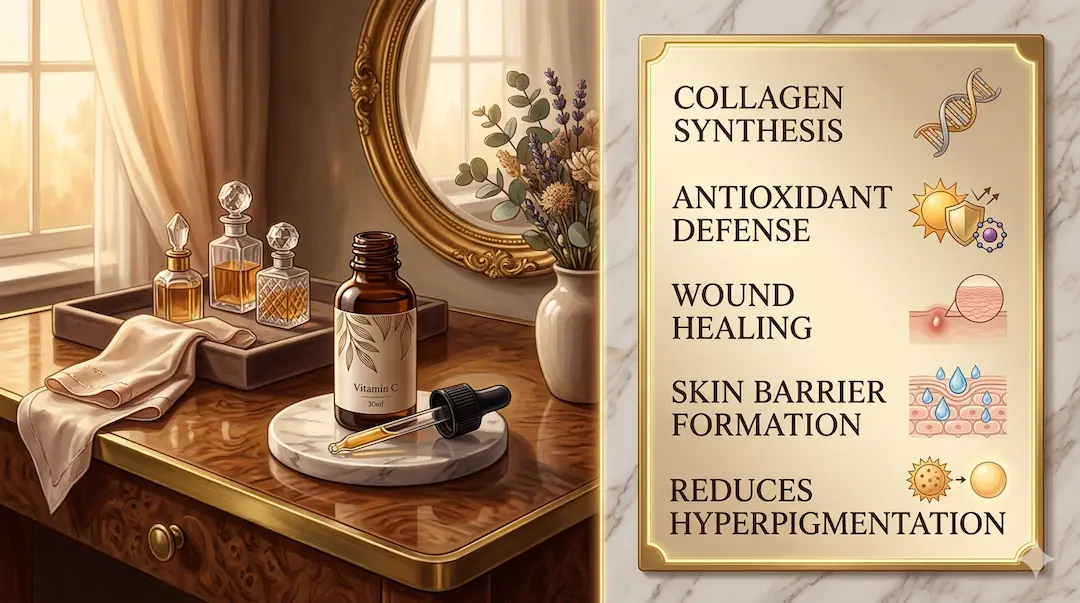
    When you use a Vit C serum, you’re applying one of the most powerful antioxidants directly to your skin. Vitamin C (also called L-ascorbic acid) helps your skin defend itself against daily environmental stress like UV light, pollution, and free radicals. These invaders can break down collagen and weaken the skin barrier, making your skin feel dry, rough, or irritated.

    Studies show that topically applied Vitamin C enhances collagen production, strengthens the skin’s protective layer, and helps repair minor damage from the sun or pollution. This is why your skin often looks smoother, plumper, and more resilient after using Vitamin C consistently.

    Why Your Skin Looses Vitamin C

    Your skin naturally stores Vitamin C, but daily habits like prolonged sun exposure, pollution, smoking, and poor diet can slowly drain these levels. When your skin’s Vitamin C decreases, it has a harder time repairing itself, producing collagen, and protecting against oxidative stress. This is one reason your skin might look dull, saggy, or uneven as you age.

    Why This Vitamin C Loss Matters to You

    Vitamin C serum plays several key roles in maintaining healthy skin for you. It helps your body produce collagen, which keeps your skin firm and elastic. It also acts as a powerful antioxidant, neutralizing free radicals that damage cells and accelerate aging. Research shows Vitamin C can support wound healing, strengthen the skin barrier, and reduce the appearance of pigmentation and uneven skin tone

    In short, Vitamin C isn’t just about brightness; it’s about building and repairing the skin’s natural defenses so you can maintain a healthy, radiant complexion.

    When Do You Need Vitamin C Serum

    If your skin often looks dull, feels rough, or shows early signs of aging, a Vitamin C serum could be a game-changer. It’s especially helpful if you spend time in the sun, live in a polluted city, or notice that your skin takes longer to recover from breakouts or irritation. These are signs that your skin barrier is under stress and could benefit from extra antioxidant support. Read our article on Smog-Aging to understand how pollution affects your Skin.

    How Can Yoy Choose the Best Vitamin C Serum

    Not all Vitamin C serums are created equal. Look for products that list L-ascorbic acid as the main ingredient, since this is the most stable and effective form. A good concentration is usually between 10% and 20%, and the formula should be slightly acidic (pH around 3.5) to allow proper absorption. Also, choose a serum stored in a dark bottle to protect it from light, which can break down the Vitamin C.

    A Vitamin C serum is more than just a skincare trend—it’s a powerful tool for supporting your skin barrier and keeping your complexion healthy. Whether you’re fighting dullness, uneven tone, or early signs of aging, including Vitamin C in your routine can make a visible difference.

    If you are too confused about skin care products, we simplified it for you. A single article that covers all the modern skin care elements, what they do, and how to use.

    Frequently Asked Questions

    How to Use Vitamin C Serum?

    Dermatologists generally recommend using a Vitamin C serum once daily in the morning, on clean, dry skin, before moisturizer and sunscreen. Pick a stable formula with 10–20% L‑ascorbic acid (or a gentler derivative if you’re sensitive), apply a few drops, and let it absorb for about a minute before layering the next product. Since Vitamin C can make your skin slightly more sensitive to the sun, daily broad‑spectrum sunscreen is essential when using it during the day.

    How often should you use a Vitamin C serum?

    Most people benefit from using a Vitamin C serum once a day, usually in the morning, after cleansing and before moisturizer and sunscreen. If your skin is sensitive, you can start every other day and slowly build up to daily use as your skin adjusts.

    Can Vitamin C serum actually help your skin barrier?

    Yes — Vitamin C serum boosts antioxidant protection, supports collagen, and helps the skin recover from daily damage like UV and pollution. By strengthening the skin’s defenses, it can make your barrier more resilient and your texture smoother over time.

  • The Myth That Everyone Still Believes.

    The Myth That Everyone Still Believes.

    Do Pores Open and Close

    If you want to learn everything about “Skin Barrier” and “How to take care of it“, Read full length articles.

    The Truth Behind Pores Open and Close Myth

    Pores on your skin are the visible openings of hair follicles and oil glands. They do not have muscles, so they cannot physically open or close like a flap or valve. What actually changes is how big or small they apparently look depending on oil, swelling, hydration, and the condition of the skin around them.

    Why The Myth Exists

    You must understand that Heat does not make pores truly open, but it sure can make them look more obvious. When skin gets warm, blood flow increases, the face can look a little puffier, and oil may move more easily to the surface. The heat also causes dehydrattion, and as a result, makes the edges around pores look sharper and more visible. Thus, you think, your pores are open.

    What Steam and Ice-Rubs Really Do

    Steam softens the outer layer of your skin and loosens oil, debris, and dead cells, which can make cleansing or extraction easier. That can be helpful in small, controlled doses, but long steaming can also increase water loss (TEWL)and irritate sensitive skin. Ice or cold water can calm redness for a short time, but it does not permanently shrink pores—it only makes them look tighter for a while.

    A Better Long-Term Strategy

    If your goal is smoother-looking pores, the real fix is daily consistency. Use a gentle cleanser, keep skin hydrated, protect it from UV, and use ingredients that help keep oil and dead skin from building up, like niacinamide or salicylic acid if your skin tolerates them. Over time, healthy skin around the pore makes the pores look less noticeable without any harsh tricks.

    Pores do not actually open or close, but they do look different depending on heat, oil, hydration, and the health of the skin barrier. Steam may soften buildup, and cold may calm redness, but neither changes the pore itself. If you want pores to look cleaner and less visible, the smartest move is simple: keep the barrier strong, the skin balanced, and the routine gentle.

    Curious what happens when water escapes your barrier and how to stop it? Dive into our TEWL Masterclass – because understanding leaks is the first step to lasting glow.

    Frequently Asked Questions

    Do pores really open and close?

    No, pores do not physically open or close like a door. They are fixed openings of hair follicles and oil glands without muscles, so their size stays the same. Heat, steam, and cold only change how visible they look by altering oil flow, swelling, and skin texture for a short time.

     Does squeezing pores make them bigger?

    Yes, rough squeezing can damage the skin and weaken the tissue around the pore, which may make pores look stretched or larger over time. Forceful picking can also cause redness, broken capillaries, infection, and dark marks, especially in darker skin tones.

    How can I make my pores look smaller without opening them?

    You can’t change the actual pore size, but you can make them look smaller by keeping the skin clean, hydrated, and protected. Gentle cleansing, consistent moisturizer, sunscreen, and ingredients like niacinamide or salicylic acid help reduce oil and dead‑skin buildup, so pores appear less obvious.

  • The Reason Your Daily Skincare is Not Working & What You Need to Do.

    The Reason Your Daily Skincare is Not Working & What You Need to Do.

    Daily Skincare for A Damaged Skin Barrier

    If you want to learn everything about “Skin Barrier” and “How to take care of it“, Read full length articles.

    Signs Your Barrier Is Struggling

    You should know your skin barrier is damaged if you see signs like sting from even the gentle products or sudden sensitivity to products that you have used since long, persistent redness, or excessive dryness even with moisturizer. Even a patchy makeup is a sign. Read Signs of Skin Barrier Damage for more.

    Why Barrier Damage Changes Daily Skincare Requirements

    If you see any of the signs above, it means skin cannot hold water properly and cannot block external irritants well. That means the same products that once felt helpful may suddenly feel too strong, too active, or just plain uncomfortable. So the goal is not to do more, but to choose a Daily Skincare that repairs the barrier.

    Morning Routine: Start Soft, Stay Calm

    Start with a gentle, low-pH cleanser – that too only if you really need it; if your skin is dry or sensitive, a water rinse may be enough in the morning.

    Follow up with a simple hydrating step like a serum or light essence if your skin feels tight.

    Use a barrier-supporting moisturizer with ceramides, cholesterol, and fatty acids. The 3:1:1 Ratio Matters.

    Finish with broad-spectrum sunscreen every day, no matter what the weather.

    Evening Routine: Cleanse Gently, Repair Deeply

    If you wore sunscreen or makeup, start with a gentle cleansing balm or oil.

    Follow with a mild cleanser for a short time only, then rinse with lukewarm water.

    Apply a soothing serum only if your skin can tolerate it, such as niacinamide, panthenol, or ectoin.

    Seal with a moisturizer that includes ceramides, cholesterol, and fatty acids.

    If a few spots are very dry, add a thin layer of petrolatum or ointment only on those areas.

    Remember, If Your Skin Is Oily

    Choose gel creams or light lotion textures instead of thick heavy creams.

    Keep cleansing gentle and avoid scrubs, cleansing brushes, or harsh foaming washes.

    Niacinamide can be useful because it supports both oil balance and barrier repair.

    And, If Your Skin Is Dry

    Use a creamier cleanser or just rinse with water in the morning.

    Choose richer moisturizers with ceramides, cholesterol, and fatty acids.

    If needed, add a thin occlusive layer at night on very dry spots.

    Damaged skin does best with a calm routine, not an aggressive one. Clean gently, moisturize wisely, protect from sun, and adjust your Daily Skincare for your skin type and weather. Once the barrier gets the support it needs, the skin often feels softer, looks less reactive, and starts behaving like itself again.

    Curious what actually causes damage to the skin barrier in first place? Dive into our article about all factors damaging your skin barrier.

    Frequently Asked Questions

    What are the signs of a damaged skin barrier?

    Common signs include stinging, burning, redness, tightness, flaking, and sudden sensitivity to products that used to feel fine. Your skin may also look dull, rough, or feel uncomfortable even after moisturizing.

    How do you repair a damaged skin barrier fast?

    The fastest way is to choose a dently daily skincare routine: use a mild cleanser, a barrier-supporting moisturizer, and sunscreen every day. Avoid scrubs, strong acids, and too many actives until your skin feels calm again.

    What ingredients help fix skin barrier damage?

    Try to include ceramides, cholesterol, fatty acids, glycerin, panthenol, niacinamide, and petrolatum in your daily skincare. These help the skin hold water better, calm irritation, and rebuild the barrier over time.

  • The 3:1:1 Ratio and Ceramides: The Secret Chemistry Behind Resilient Skin

    The 3:1:1 Ratio and Ceramides: The Secret Chemistry Behind Resilient Skin

    The 3:1:1 Ratio & Ceramides

    If you want to learn everything about “Skin Barrier” and “How to take care of it“, Read full length articles.

    What Exactly Is the 3:1:1 Ratio?

    Think of your skin like a luxury wall. The “bricks” are skin cells, and the “mortar” holding them together is made of fats called lipids – primarily ceramides, cholesterol, and fatty acids. In healthy skin, these exist in the perfect ratio of 3 parts ceramides1 part cholesterol, and 1 part fatty acids. It’s this precise blend that keeps your barrier smooth, strong, and leak‑proof. Lose that balance, and your wall starts to crumble.

    How to Protect This Golden Formula in the First Place

    Now, preserving your 3:1:1 ratio is easier than you think – it begins with gentle choices. Just Use a pH‑balanced, non‑foaming cleanser that won’t strip natural oils. Follow with a lightweight moisturizer during humid months and a richer lipid cream in colder weather. If you have oily skin, go for gel‑based or water‑cream formats that mimic natural lipids without clogging; if you’re dry or sensitive, look for balms or barrier serums packed with ceramides and fatty acids.

    Signs of Disturbed 3:1:1 Ratio

    Let’s say, for any reason, your mortar has been distrubed. When one lipid type (usually ceramides) drops, that tight “mortar” between your skin cells starts loosening. The protective barrier becomes patchy, your acid mantle goes off balance, and the once‑solid structure turns leaky. You’ll feel it as tightness, redness, or that rough, papery texture that just won’t disappear. Read Signs of Skin barrier damage for more details.

    Ceramides: The Cornerstone Molecule

    Now something about the trending Ceramides. Ceramides are the backbone of your barrier – the soldiers that hold every cell together. When they deplete (often due to harsh cleansers, over‑exfoliating, or age), your skin loses its power to keep moisture in and pollutants out. Imagine pulling bricks from a wall – eventually it caves. That’s what ceramide loss does at a microscopic level.

    The TEWL Connection: Why No Amount of Moisturizer is Enough

    Transepidermal Water Loss (TEWL) might sound technical, but think of it as your skin’s “hydration leak.” When the 3:1:1 ratio crumbles, your lipid layer can’t hold water inside anymore, so it evaporates, leaving your skin dry even after multiple moisturizer layers. High TEWL means your barrier is crying out for structure, not just hydration.

    How to Restore the 3:1:1 Ratio and Ceramides

    If the 3:1:1 Ratio has been disturbed, the key is to rebuild, not overload. Switch to a moisturizer designed with the 3:1:1 lipid ratio – one that includes ceramides, cholesterol, and fatty acids in balanced amounts. Pair it with a gentle, pH‑balanced cleanser (around 5.5) and avoid foamy “squeaky‑clean” formulas that strip your acid mantle. For high‑heat climates like Lahore, Riyadh or Delhi, choose barrier creams labeled “thermal stable” or “occlusive recovery” – they reinforce structure under heat stress.

    Your skin barrier isn’t just a layer—it’s living architecture. The 3:1:1 ratio keeps that architecture stable, supple, and self‑healing. When it’s lost, you can see it and feel it in every patch of dryness, every hint of roughness, and that frustrating “nothing works anymore” moment. But now you know where to start.

    Curious what happens when water escapes your barrier and how to stop it? Dive into our TEWL Masterclass—because understanding leaks is the first step to lasting glow.

    Frequently Asked Questions

    How to repair skin barrier?

    To repair skin barrier damage, you must transition from “active” treatments to a recovery-first protocol. This involves three steps: first, stop all exfoliants and harsh surfactants. Second, apply a physiologic moisturizer with the 3:1:1 lipid ratio (Ceramides, Cholesterol, Fatty Acids) to damp skin. Finally, seal the barrier with an occlusive layer at night to prevent moisture leakage while your cells undergo natural circadian repair.

    What is the 3:1:1 Ratio?

    The 3:1:1 lipid ratio is a clinically proven formulation of 3 parts Ceramides, 1 part Cholesterol, and 1 part Fatty Acids. This precise balance mimics the natural “glue” of a healthy skin barrier. Research indicates that while ceramides are vital, they require the support of cholesterol and fatty acids in this specific proportion to effectively “plug” moisture leaks and accelerate the repair of a damaged stratum corneum.

    Why is the 3:1:1 ratio moisturizer better than standard moisturizers?

    While standard moisturizers provide essential hydration and surface softening, they primarily act as a temporary “top coat.” In contrast, a 3:1:1 ratio moisturizer is biomimetic—it provides the exact molecular blueprint (Ceramides, Cholesterol, and Fatty Acids) your skin requires to physically repair its architecture.

    Furthermore, in extreme heat (above 40°C), the skin’s natural lipid organization can reach a “phase transition” point, becoming more permeable and prone to moisture loss. A 3:1:1 formulation reinforces the thermal stability of your skin barrier, ensuring it remains structurally sound and organized even under intense environmental stress. You aren’t just masking dryness; you are reinforcing the barrier’s foundation.

  • 5 Signs of Skin Barrier Damage and How to Fix It Gently

    5 Signs of Skin Barrier Damage and How to Fix It Gently

    5 Signs of Skin Barrier Damage and How to Fix It Gently

    Ever feel like your skin has suddenly turned against you—stinging at every serum, getting red for no reason, or feeling tight no matter how much cream you use? Those are classic SOS signals of a weakened skin barrier.

    If you want to learn everything about “Skin Barrier” and “How to take care of it“, Read full length articles.

    What is the Skin Barrier?

    Your skin barrier is the outermost layer of your skin. It works like a protective shield to:

    • Keep moisture inside the skin
    • Block irritants, pollution, and microbes
    • Reduce redness and sensitivity

    5 Signs of Skin Barrier Damage

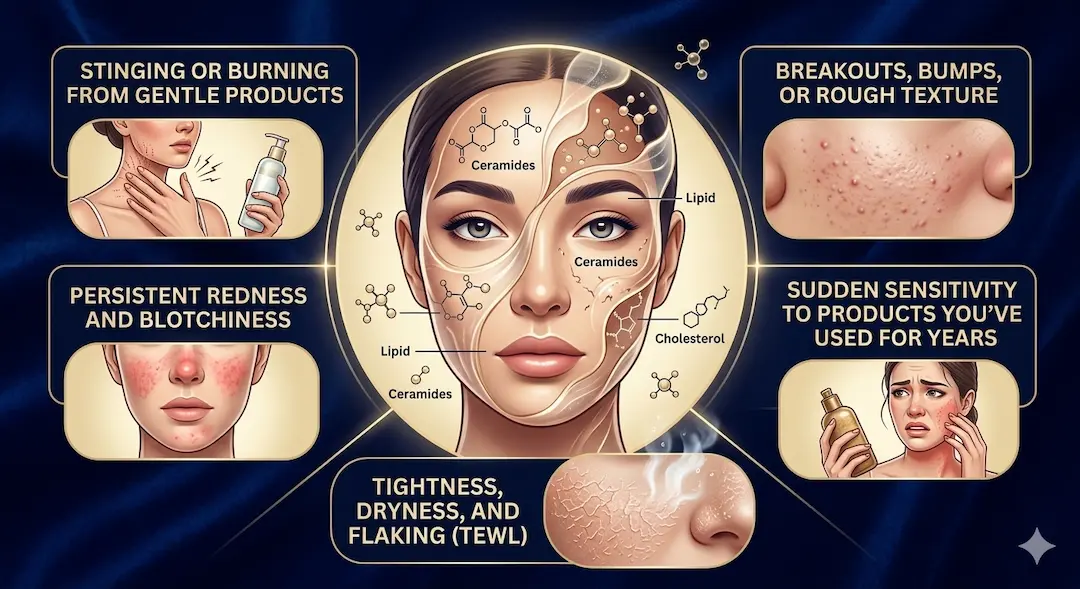
    1. Stinging or Burning From Gentle Products

    That familiar sting from a cleanser or moisturizer that once felt totally fine? That’s your skin waving a red flag. When the barrier thins, even the mildest formulas can suddenly feel fiery – especially around your nose and cheeks. It’s not that your skincare changed; your skin’s tolerance did.

    2. Persistent Redness and Blotchiness

    When your skin stays flushed long after cleansing – or develops warm patches on your nose, chin, or cheeks – it means your natural armor has weakened. A fragile barrier struggles to handle tiny triggers like touch, temperature changes, or even a gentle breeze.

    3. Tightness, Dryness, and Flaking (TEWL)

    If your skin feels tight moments after washing – even with moisturizer on – it’s losing water faster than it can hold it. This invisible water loss is called Transepidermal Water Loss (TEWL) and has nothing to do with sweat. Once it kicks in, dry patches, roughness, and dullness appear no matter how rich your cream is.

    4. Sudden Sensitivity to Products You’ve Used for Years

    If your trusty favorites now cause tingling, redness, or sudden breakouts, your skin isn’t being “picky”—it’s exhausted. Over‑exfoliating acids, too many actives, or harsh cleansers can slowly wear down barrier lipids and proteins, stripping away your built‑in protection.

    5. Breakouts, Bumps, or Rough Texture

    When the barrier breaks, your skin loses its self‑control. Oil, bacteria, and dead cells get stuck instead of shedding smoothly, leading to small bumps, random breakouts, or an uneven texture that no filter can hide. The more you layer to “fix it,” the worse the chaos can get.

    What Causes Skin Barrier Damage 

    • External Factors such as Very Hot & Humid or Cold & Dry Weather, Pollution / Smog, UV exposure, and Artificial cooling / heating.
    • Internal Factors such as Diet, hydration habits, lifestyle and daily mental stresses.
    • Over enthusiastic, agressive Skincare Routine

    The more sensitive your skin is, the easier it is for these factors to weaken your barrier. Read the article What Causes Skin Barrier Damage for better understanding. 

    While explaining the signs of skin barrier damage, this Abstract scientific illustration shows the external skin barrier aggressors and the barrier defenses
    While Covering the signs of skin barrier damage, this Abstract scientific illustration shows the internal skin barrier aggressors and the barrier defenses

    How to Fix Skin Barrier Damage

    Repairing the barrier isn’t about adding more aggressive treatments—it’s about simplifying and soothing.

    Strip Back Your Routine

    • Avoid Pause new actives and strong exfoliants. Focus on a minimal routine:
    • Gentle cleanser
    • Hydrating serum
    • Barrier-supporting moisturizer
    • Daytime SPF
    • The goal is to calm inflammation, not chase perfection.

    Choose Fragrance-Free or Very Low-Scent Formulas

    For sensitive or reactive skin, fragrance-free is usually the safest choice—especially for leave-on products like serums, lotions, and oils. This reduces one of the most common triggers for irritation and barrier damage.

    Look for Soothing, Barrier-Loving Ingredients

    The ‘mortar’ inside your skin barrier is made up of ceramides, cholesterol, and free fatty acids. Using fragrance‑free formulas with ceramides, cholesterol, and fatty acids in a physiologic ratio (often in 3:1:1 Lipid Ratio) can help recover and reverse signs of barrier damage. Other natural products capable of providing long term support include :

    • Aloe vera and vegetable glycerin (hydration)
    • Shea butter and cocoa butter (nourishing emollients)
    • Jojoba, sweet almond, and squalane (supportive oils)
    • Oat, calendula, and chamomile extracts (soothing botanicals)

    Be Gentle With Cleansing and Exfoliation

    Use lukewarm—not hot—water, and limit exfoliation while your barrier heals. When you do exfoliate, choose a gentle method and follow with a rich, comforting moisturizer or body butter.

    Moisturize Twice Daily (Face & Body)

    Barrier repair needs consistency. Apply moisturizer morning and night, and don’t forget areas like the neck, chest, and hands. For the body, richer textures—like whipped butters and oils—help seal in moisture and protect fragile skin.

    Frequently Asked Questions

    What is Skin Barrier Damage?

    Skin barrier damage (also called a “compromised” or “broken” skin barrier) means the outermost layer of your skin is not working as well as it should. Normally, this layer acts like a protective wall that keeps moisture in and irritants out. When it’s damaged, water escapes more easily and irritants can get in more easily, so your skin can feel:
    – Dry, tight, rough, or flaky
    – Red, itchy, or stinging
    – More sensitive than usual (products that once felt fine now burn or irritate)

    What Causes Skin Barrier Damage?

    Skin barrier damage happens when the outer layer of your skin is weakened so it can’t hold in moisture or block irritants as well as it should. Common causes include:

    Harsh or over‑washing – Using very foaming cleansers, washing too often, or wiping the skin too hard can strip away natural oils.
    Over‑exfoliating – Using scrubs, acids, retinoids, or scrubs too often can thin the protective layer and make skin raw or sensitive.
    Extreme weather and dry air – Cold, wind, low humidity, and indoor heating all increase water loss and dry out the barrier.
    Strong ingredients and fragrances – High‑strength actives, alcohol‑based products, or strong fragrances (synthetic or essential oils) can irritate and inflame sensitive skin.
    Sun exposure and pollutants – Too much UV light and air pollution can break down the skin’s protective lipids and increase sensitivity over time.

    Genetics, aging, stress, lack of sleep, and certain skin conditions (like eczema or acne) can also make someone more prone to barrier damage.

    How to Fix a Damaged Skin Barrier

    Fixing a damaged skin barrier is less about “treating” and more about stopping what is hurting it and gently supporting recovery.
    Simplify your routine – Stop harsh cleansers, scrubs, strong acids, retinoids, and anything that stings or burns. Stick to just a gentle cleanser, a hydrating serum (like hyaluronic acid or niacinamide), a barrier‑repair moisturizer, and daytime sunscreen.
    Use barrier‑supporting ingredients – Choose fragrance‑free products with ceramides, cholesterol, and fatty acids (often in a 3:1:1–type ratio) plus humectants such as glycerin or hyaluronic acid. These fill the “gaps” in the barrier and help it retain moisture.
    Be gentle with cleansing and water – Wash with lukewarm water, use a gentle, pH‑balanced cleanser, and pat dry—don’t rub. Avoid very hot showers or face‑washing with hot water, which strip natural oils.
    Moisturize consistently – Apply a rich, fragrance‑free moisturizer at least twice a day, especially on damp skin, to lock in water. For very dry or cracked areas, a thin layer of petrolatum‑type ointment at night can speed healing.
    Give it time – With a calm, consistent routine, most mild to moderate barrier damage improves in about 2–8 weeks, though very sensitive or severely damaged skin can take longer.

  • Never mix Acne with Damaged Skin Barrier. It is a Disaster.

    Never mix Acne with Damaged Skin Barrier. It is a Disaster.

    Acne or Damaged Skin Barrier: How to Tell The Difference

    If you want to learn everything about “Skin Barrier” and “How to take care of it“, Read full length articles.

    What is the Difference

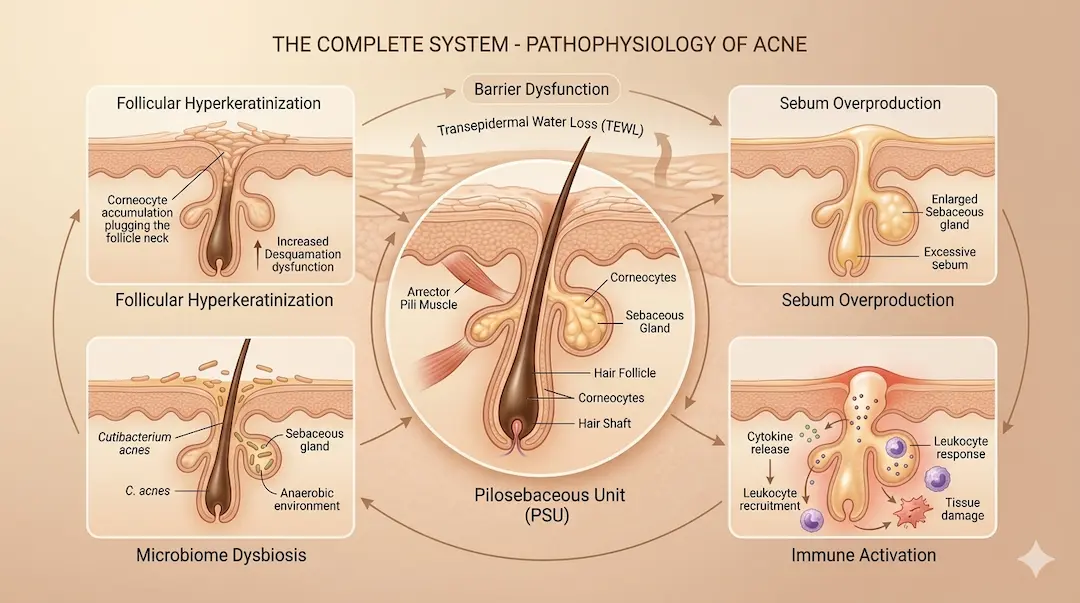
    Acne happens when pores get clogged, oil production goes up, and a specific acne bacteria called C. acnes builds up. That’s why breakouts usually look like clear whiteheads, blackheads, or red, inflamed pimples that show up in your usual spots.

    Barrier Damage, on the other hand, happens when your outermost skin layer becomes weak and leaky, water escapes too fast (TEWL), and your skin gets irritated by harsh cleansers, over‑exfoliation, or climate stress. The “breakouts” you see here are more like a rash of tiny bumps along with redness, burning, tightness, and rough texture. Read Signs of barrier damage in detail here.

    How to be Certain It’s Acne

    True acne, also called Acne Vulgaris, is more predictable, structured, and feels like defined clogged pores rather than a rash. Common signs / stages include:

    Blackheads and whiteheads: pores plugged with oxidized oil and dead skin.

    One of many infographics expalinging Acne to help idnetify if it Acne or Damaged Skin barrier.

    Papules and pustules: red, tender bumps, often with a bit of visible pus at the top.

    One of many infographics expalinging Acne to help idnetify if it Acne or Damaged Skin barrier.

    Nodules and cysts: deeper, hard, painful bumps under the skin linked to hormones or strong inflammation.

    One of many infographics expalinging Acne to help idnetify if it Acne or Damaged Skin barrier.

    Acne aestivalis (summer acne): small bumps triggered by heat, sweat, and heavy creams.

    One of many infographics expalinging Acne to help idnetify if it Acne or Damaged Skin barrier.

    Bottom line is, if it is Acne you are facing, the breakouts will appear in your usual zones like jawline, chin, cheeks, or forehead.

    What if You Treat Wrong

    If you treat barrier damage like acne with strong acids, scrubs, or harsh cleansers, your skin becomes more inflamed, and tiny bumps spread.

    On the other hand, if you treat true acne like barrier damage – using very heavy creams that block pores – you can trap oil, sweat, and bacteria inside, making congestion worse. The safest way is to calm your barrier first, then slowly add acne treatments only when your skin feels stable again.

    A Safe Approach

    If you’re unsure whether you’re dealing with acne or barrier damage, stop using acids and retinoids for 10 – 14 days. Use a gentle, barrier‑supporting routine. If redness, tightness, and stinging improve, your barrier was the main issue. If you still see clear clogged pimples, you can add targeted acne treatments later. Read a Barrier First Skin care routine here.

    When to Add Acne Treatments Back

    Once your skin no longer burns or stings and feels less tight after cleaning, you can slowly reintroduce acne treatments (usually after 2 – 4 weeks). Waiting for stability helps you add acne products safely without damaging your barrier all over again.

    Learning the difference between acne and barrier damage helps you choose the right products, save money, and avoid long‑term sensitivity. Over time, your skin will feel calmer, look smoother, and break out less often—because it’s finally being treated the way it truly needs.

    Curious what happens when water escapes your barrier and how to stop it? Dive into our TEWL Masterclass—because understanding leaks is the first step to lasting glow.

    Frequently Asked Questions

    What is Acne Vulgaris?

    Acne vulgaris is a chronic, multi-factorial inflammatory disease that initiates through a process called follicular hyperkeratinization. This occurs when dead skin cells fail to shed properly and instead build up within the pore, creating a physical blockage.

    Does Acne Damage Skin Barrier?

    The relationship between acne vulgaris and the epidermal skin barrier is a bidirectional “vicious cycle.” Active inflammation inherently degrades the stratum corneum—the skin’s outermost protective shield. This localized immune response releases cytokines and proteases, which are enzymes that break down the organized “mortar” of ceramides, cholesterol, and fatty acids.
    This damage leads to a “leaky” barrier, which facilitates Transepidermal Water Loss (TEWL), where vital moisture escapes through the skin. Conversely, this compromised barrier allows environmental pollutants like PM2.5 and urban smog to penetrate deeper into the dermis, triggering a secondary wave of inflammation. Furthermore, as the skin’s surface shifts toward an alkaline pH, it favors the growth of pathogenic bacteria over the skin’s healthy, commensal microbiome, essentially “priming” the skin for more frequent acne episodes.

    What are different types of Acne

    Comedonal Acne (Blackheads and Whiteheads) Comedonal acne represents the non-inflammatory stage of the disease. Closed comedones, or whiteheads, appear as small, flesh-colored bumps where the follicle is completely obstructed. Open comedones, known as blackheads, occur when the follicular opening dilates and the trapped keratin-lipid plug is exposed to air. This exposure causes the plug to oxidize and turn dark, which explains what does acne vulgaris mean in its earliest, most visible form.
    Papules and Pustules These lesions signal the transition into inflammatory acne. Papules are tender, red bumps under 5mm in diameter caused by follicular rupture and the resulting immune response. Pustules, often called “pus pimples,” are similar but contain a visible collection of neutrophils and cellular debris, appearing as white or yellow fluid at the surface.
    Nodules and Cysts These are severe, deep-tissue lesions that represent a high risk for permanent damage. Nodules are large, solid, painful lumps lodged deep within the dermis. Cysts are fluctuant, fluid-filled sacs. Both types destroy the underlying collagen framework, which is the primary cause of atrophic acne scars—the depressions or “pits” left behind after healing.
    Acne Aestivalis (Mallorca Acne) Often mistaken for a standard breakout, this is a monomorphic eruption of uniform small bumps triggered by the intersection of high heat, sweat, and UV radiation. It is frequently aggravated by the use of heavy, occlusive sunscreens that trap thermal energy and moisture against the skin.

  • Does Your Skin Know How to Survive Summer?

    Does Your Skin Know How to Survive Summer?

    Summer Skin Care Masterclass

    If you want to learn everything about “Skin Barrier” and “How to take care of it“, Read full length articles.

    What Hot Weather Does to Your Skin

    When it gets hot, your body opens up blood vessels in the skin to cool down, which can make your face look red or puffy. Heat also makes your outer skin layer less tightly packed, so water escapes faster and irritants can sneak in more easily (a process seen in studies as increased TEWL). This “softening” of your barrier means your skin loses moisture faster and feels more sensitive, even if you’re using the same routine as before.

    Dry vs. Humid Heat: How They Affect Your Skin

    In very dry, arid heat (like Lahore, Riyadh, or Delhi), the air pulls moisture out of your skin quickly, making your barrier feel rough, tight, and reactive. You may notice that your moisturizer seems to “disappear” right after you apply it, because the dry air is stealing the water. In humid heat (like Karachi or Mumbai), sweat doesn’t evaporate easily, so your skin feels sticky and pores can get clogged more easily, even though your skin may look plump on the surface.

    Are You Living in Smog, High UV, and Pollution?

    If you live in a city with pollution and strong sun, heat doesn’t act alone, it teams up with smog and UV rays to create extra stress. Pollutants like PM2.5 can stick to your skin surface, especially when your barrier is already weakened, and they can trigger irritation and dullness. When sweat, oil, and pollution mix, your skin can feel grimy and clogged, which is why many people experience more breakouts or congestion in summer city life. Read more about effects of Smog on your skin here.

    Be Aware of That Cool AC Breeze

    Spending your day in air‑conditioned rooms after facing extreme heat may feel refreshing, but it can stress your skin. AC removes moisture from the air, so your skin loses water faster and feels tight or dry, like a mini “indoor desert”. Constant switching between hot outdoors and cool‑dry indoors can leave your skin confused, sometimes oily from sweat, sometimes dry from AC, all in one day.

    How to Care for Oily Skin in Summer

    Even if your skin feels oily in summer, it may still be losing water while looking shiny. The best summer skin care strategy is to use lightweight, pH‑balanced cleansers and oil‑free or gel‑based moisturizers that hydrate without clogging pores. Choose non‑comedogenic sunscreens and avoid heavy creams that trap sweat and oil, since this can worsen congestion and acne in humid weather.

    Summer Skin Care for Dry Skin

    If your skin leans dry, summer can actually make it feel more reactive, not less. Low humidity, strong sun, and frequent AC exposure can increase water loss and make your skin feel tight, rough, or flaky regardless of how much you moisturize. In this situation, a light but lipid‑supportive moisturizer with ingredients like ceramides, hyaluronic acid, and glycerin can help your barrier retain moisture without feeling heavy.

    And if You Have Acne Prone Skin

    Heat and humidity can worsen acne by increasing sweat, oil, and the chance of clogged pores, especially if your Summer Skin care is too heavy or too harsh. The smart move is to keep your routine simple: gentle cleansing, lightweight non‑comedogenic moisturizer, and daily broad‑spectrum sunscreen, then slowly add acne‑targeting ingredients like salicylic acid or retinoids only when your skin feels stable. Avoid creamy, pore‑clogging products that trap sweat and irritate already inflamed skin. If you have Acne, you must read this article on Acne and Skin Barrier Damage.

    Summer doesn’t just change your mood, it quietly changes how your skin behaves. By understanding how heat, pollution, and cooling systems affect your barrier, you can protect your skin instead of reacting to the damage after it happens. A simple, thoughtful summer skin care routine that matches your climate, skin type, and lifestyle keeps your skin calm, comfortable, and glowing all season.

    Curious what happens when water escapes your barrier and how to stop it? Dive into our TEWL Masterclass – because understanding leaks is the first step to lasting glow.

    Frequently Asked Questions

    How to take care of skin in summer?

    Build Your Thermal Shield: Swap heavy creams for breathable ceramide-rich gel-emulsions mimicking the skin’s natural 3:1:1 lipid matrix. This stops TEWL without the suffocating “oil slick.”
    Master the pH: Sweat shifts your Acid Mantle alkaline. Use pH-locked cleansers to gently dissolve “dirty sweat” before it triggers inflammation cascades.
    Morning Exposome Armor: SPF 50+ + antioxidant “Molecular Reset” (ectoin, Vitamin C) neutralizes the UV-PM2.5 toxic storm.
    Nightly Circadian Repair: Glycerin + panthenol cool your surface temperature during the barrier’s vulnerable nocturnal window.
    Result: No stinging, no congestion—just summer skin that obeys thermodynamics.

    How to take care of oily skin in summer ?

    To take care of oily skin in summer naturally, you must master physics, not just products. Heat spikes sebum by 10% per 1°C, causing a rebound oil chaos. Stop the battle with stripping soaps; instead, use pH-locked, sulfate-free cleansers to protect your Acid Mantle from heat related effect.

    UV rays and PM2.5 smog oxidize your squalene into sticky, pore-clogging monohydroperoxides. Neutralize this by applying antioxidants like Green Tea EGCG or Silymarin before your pores explode. Remember that sebum offers zero protection against skin dehydration (TEWL). Layer High-MW Hyaluronic Acid and Glycerin for a weightless water pull that stops the hidden dryness without a greasy film.

    For a natural “Molecular Reset,” use weekly Kaolin or Bentonite clay masks to vacuum out city grime and excess lipids. Finally, since high temperatures make lipids “runny,” use a chilled Rose Water mist to constrict capillaries and provide an instant thermal reset.

    How to take care of dry skin in summer?

    Stop Flash TEWL: Low humidity brutally dehydrates your barrier. Use lightweight ceramide-rich gel moisturizers that repair without trapping heat. Anchor humectants with emollients – naked hyaluronic acid backfires in desert air. Ectoin serums fight environmental dehydration. Gentle cream-to-milk cleansers remove smog without lipid stripping.

  • Skin Care Products Simplified: Choose Only What You Need.

    Skin Care Products Simplified: Choose Only What You Need.

    Are You Choosing Skin Care Products Smartly?

    If you want to learn everything about “Skin Barrier” and “How to take care of it“, Read full length articles.

    The Lipid Trio Your Barrier Loves

    Your skin barrier works best when its “mortar” is built from ceramides, cholesterol, and fatty acids in the right balance. Research shows that physiologic lipid mixtures help barrier recovery better than random single ingredients, because the skin needs all three pieces to rebuild its outer wall properly. Ceramides are especially important because they help seal the spaces between skin cells and reduce water loss. Read more about 3:1:1 Ratio here.

    Ceramides: The Quiet Fixer

    Ceramides are the ingredient people talk about most, and for good reason. They make up a large part of the skin barrier and help keep moisture in while keeping irritants out. If you have dry, sensitive, or over‑exfoliated skin, ceramides are one of the safest and most useful ingredients to look for in a moisturizer or cream.

    Humectants: The Water Magicians

    Humectants are ingredients that pull water into the skin, which is why they’re so useful when your face feels dull or dehydrated. Hyaluronic acid, glycerin, urea, panthenol, sodium PCA, polyglutamic acid, and ectoin all help the skin hold onto water in different ways. But in dry heat or strong AC, some humectants need to be sealed with a moisturizer so the water doesn’t evaporate too quickly.

    Exfoliants: Useful, But Easy to Overdo

    Exfoliating ingredients can help with rough texture, clogged pores, and dullness, but only when your barrier is strong enough to handle them. Retinoids, AHAs, BHAs, PHAs, azelaic acid, mandelic acid, and bakuchiol all have a place, but they work best when introduced slowly and not stacked in a stressful routine. If your skin is already stinging or flaking, too much exfoliation usually makes the barrier worse instead of better.

    How to Pair Skin Care Products

    The best routines usually pair ingredients instead of loading too many actives at once. For example, ceramides work well with glycerin or panthenol for dry skin, niacinamide pairs nicely with barrier creams for oily or acne-prone skin, and Vitamin C often works best in the morning with sunscreen. If you have sensitive skin, keep the routine simple and let one strong ingredient do its job instead of mixing everything together.

    An image showing Skin Care Products and Their Role in SKin Care.

    Skin care gets easier once you stop thinking in trends and start thinking in functions. Some ingredients rebuild the barrier, some hold water, some calm inflammation, and some protect against daily stress — and the best routine is the one that gives your skin exactly what it is missing.

    If you suspect skin barrier damage, we formulated a barrier first skin care routine for you.

    Frequently Asked Questions

    What do Ceramides do?

    Ceramides are one of the skin care products that make up about 40–50% of your skin’s protective lipid matrix by weight. Their primary job is to provide a cohesive, water-tight structure that locks hydration in and keeps environmental stressors out. When our harsh urban environment degrades this mortar, water rapidly escapes, which is exactly why your skin might suddenly feel tight, dry, and reactive. Replenishing them is absolutely non-negotiable for repairing your skin’s scaffolding.

    What is AHA and BHA?

    AHAs (Alpha Hydroxy Acids): These are water-soluble molecules, like Glycolic or Lactic acid. They work entirely on the surface of your skin to gently dissolve the invisible “glue” holding onto dead, dull skin cells. If your main concern is rough texture, superficial pigmentation, or a lack of surface glow, AHAs is type of skin care products that sweep that away to reveal fresh skin.
    BHA (Beta Hydroxy Acid): This is Salicylic Acid, and its superpower is that it is lipophilic (oil-loving). Because it loves oil, it bypasses your surface sebum and dives directly inside the sebaceous gland (the pore). Once inside, it dissolves the hardened lipid debris and dead cells that cause blackheads, congestion, and acne.
    Simply put: AHA sweeps the surface for a polished glow, while BHA deep-cleans the pore from the inside out.

    How to reconstitute Peptides?

    In high-end clinical skincare, we don’t really “reconstitute” peptides in the traditional pharmaceutical sense (like a lyopholized powder) unless you are working in a compounding lab. For your daily routine, “reconstituting” the power of peptides is all about Bio-Availability—ensuring these fragile amino acid chains actually reach their cellular targets.
    In the list of skin care products, peptides are delicate “messengers.” If you drop them into a hostile environment, the message never gets delivered. Here is how you “activate” them for maximum efficacy:
    The pH Rule: Peptides are extremely sensitive to low pH environments. If you apply a peptide serum immediately after a strong Vitamin C (L-Ascorbic Acid) or a Glycolic Acid toner, the acid can physically break the peptide bonds, essentially “denaturing” the ingredient before it works.
    The Hydration Primer: Peptides travel best through a hydrated medium. Applying them to slightly damp skin (after a humectant mist or essence) allows them to glide through the stratum corneum more effectively.
    The Molecular Pairing: To truly “reconstitute” the firming effects of peptides like Matrixyl or Copper Peptides, pair them with Niacinamide. Niacinamide strengthens the barrier, ensuring the peptides aren’t lost to the atmosphere and can focus on signaling collagen production.

  • Transepidermal Water Loss: The Silent Thief of Your Glow”

    Transepidermal Water Loss: The Silent Thief of Your Glow”

    Transepidermal Water Loss

    If you want to learn everything about “Skin Barrier” and “How to take care of it“, Read full length articles.

    What TEWL Really Means

    TEWL stands for transepidermal water loss, which is simply the water your skin keeps losing into the air all day long. A little loss is normal, but when the number climbs too high, your skin starts acting dry, stressed, and easily irritated.

    It is not the same as sweating. Sweat is active and visible, while TEWL is a quiet, constant escape of water through the skin barrier. Think of it like a slow leak in a pipe, not a dramatic spill.

    Hydration Is Not The Same

    This is where many routines get confusing. A skin can feel “hydrated” right after a serum, but if the barrier is damaged, that water may escape quickly anyway. In other words, adding moisture is helpful, but sealing the leak is what actually keeps skin comfortable.

    That’s why a skin with high TEWL can still feel tight even after moisturizing. It’s like pouring water into a bucket with a crack in it.

    Where Water Escapes Fastest

    Not all parts of the face lose water at the same speed. The cheeks usually react more easily, the lips and eyelids are especially vulnerable, and even the forehead can get stressed depending on oil flow, weather, and product use. That’s why one product can feel perfect on one area and too much on another.

    This is also why sensitive zones often show dryness, redness, or stinging first. Your skin is basically telling you where the leak is strongest.

    What Causes Transepidermal Water Loss

    I am sure you know that the barrier is essentially a wall (if you don’t, read What is Skin Barrier). Briefly, skin cells are the bricks, and the lipids between them are the mortar that holds everything together. Those lipids are mainly ceramides, cholesterol, and fatty acids, and when they are balanced, they help keep water in and irritants out.

    The biggest causes of TEWL are anything that weakens that wall: barrier damage from over-cleansing, over-exfoliating, harsh scrubs, strong acids, alcohol-heavy products, low humidity, air conditioning, heat, UV exposure, pollution, and skin conditions such as eczema, atopic dermatitis, rosacea, and aging-related barrier decline. When the “mortar” gets damaged, the wall becomes porous and the acid mantle also struggles to stay balanced, so the skin loses water faster and becomes more reactive. Read about all factors that damage you barrier.

    Signs of Transepidermal Water Loss

    When TEWL goes up, the skin does not just get dry—it gets reactive. Redness can linger longer, products can sting that never used to sting, and your face may look dull or tired because the surface is no longer smooth enough to reflect light well.

    You may also notice tiny dehydration lines, patchy texture, flaking, roughness, itchiness, or a “nothing looks right on my skin” feeling. Yes, TEWL can also make makeup look patchy or clingy, because dry uneven skin makes foundation separate and sit badly on the surface. These are all signs that your barrier is asking for support, not more punishment.

    Weather and TEWL

    Dry air (no matter in hot weather or cold), air conditioning / heating, and windy weather all make TEWL worse. When the air around you is dry, your skin loses water more easily, and when you move between outside weather and artificial heating / cooling indoors, the barrier gets stressed even more.

    This is why the same skin can feel different in different weather. Weather changes your barrier more than most people realize.

    How to Manage TEWL

    The smartest way to reduce TEWL is to use products that work in layers. Humectants like glycerin and hyaluronic acid help draw water into the skin. Emollients like squalane and ceramides smooth the surface and fill tiny gaps. Occlusives like petrolatum or dimethicone sit on top and slow down evaporation.

    A barrier cream that contains ceramides, cholesterol, and fatty acids in a balanced formula is especially helpful because it supports the skin’s own structure instead of just sitting on it. A gentle, pH-balanced cleanser also matters because harsh foaming cleansers can strip the barrier and make water loss worse.

    TEWL is basically your skin’s invisible leak meter. If it rises, your barrier is struggling; if it stays under control, your skin usually feels softer, calmer, and more resilient. Once you learn to read that signal, skincare becomes much less random and much more effective.

    If you want suspect skin barrier damage, understand the signs of barrier damage and a barrier first daily skin care routine.

    Frequently Asked Questions

    What is TEWL?

    Think of your skin barrier like a protective shield that keeps moisture inside. Transepidermal Water Loss (TEWL) is simply a fancy name for “evaporation.” It happens when water from the deep layers of your skin (Dermis) escapes into the air through the outer protective layer (Epidermis). While some water loss is normal, a damaged barrier acts like a leaky roof, letting moisture out too fast. This is why your skin feels tight, dry, and sensitive—even after you’ve just applied moisturizer.

    What causes Transepidermal Water Loss (TEWL)?

    Think of TEWL as your skin’s “moisture leakage rate.” It increases when your protective barrier is thinned or disrupted. The most common culprits include environmental heat (which melts protective surface oils), harsh foaming cleansers that strip away your natural “glue,” and over-exfoliation. Furthermore, low humidity from air conditioning or heaters can act like a vacuum, pulling moisture out of your skin faster than you can replace it

    How to prevent Transepidermal Water Loss (TEWL)?

    To stop the “leak,” you need to hydrate and then seal. Start by applying a humectant like Hyaluronic Acid or Glycerin to the damp skin to pull moisture in. Immediately follow with a barrier cream containing Ceramides or Squalane to lock that moisture down. Think of it as closing the windows to keep the air conditioning inside. Additionally, using a humidifier in dry, air-conditioned rooms can help stop the air from “stealing” moisture from your face.

  • Skin Care Tips That Help — and Harm!!!

    Skin Care Tips That Help — and Harm!!!

    When Your Routine Is Doing Too Much

    If you want to learn everything about “Skin Barrier” and “How to take care of it“, Read full length articles.

    The Steam Trick That Isn’t So Innocent

    Steam is often treated like a pore miracle, but the truth is more ordinary and more useful. Warm steam softens dead skin and loosens debris, which can make cleansing or extraction easier, but too much heat can over-swell skin and disturb the barrier. If steam is followed by squeezing, rough tools, or harsh toners, the skin can end up more inflamed, not more clean.

    Ice Rubbing: Quick Calm, Lasting Trouble?

    Ice can briefly calm redness by narrowing blood vessels, but direct rubbing is not a smart long-term skin care tip. Extreme cold can stress already sensitive skin, and sudden hot-to-cold swings may be especially unhelpful for people with barrier damage. The skin may look temporarily “tight,” but that is not the same as being healthier.

    Cleansers That Clean Too Hard

    A cleanser should remove dirt, oil, and sunscreen — not strip your barrier like a degreaser. High-pH cleansers can swell the outer skin layer, disturb lipid structure, and make the skin feel dry and irritated; in contrast, low-pH syndet cleansers are usually kinder to the barrier. Harsh surfactants like SLS are also known to increase TEWL and irritation, especially with repeated use.

    Moisturizers That Actually Repair

    Not all moisturizers do the same job. Barrier-friendly formulas with ceramides, cholesterol, and free fatty acids help rebuild the skin’s outer layer more effectively than random single-lipid creams, especially when the skin is dry or easily irritated. Occlusives like petrolatum can also help by slowing water loss, which makes them useful on dry patches or during flare-ups.

    Actives: Powerful, But Easy to Misuse

    Retinoids, acids, and strong vitamin C can be great — but they are not automatically good for every skin, every day. Overusing exfoliating acids, retinoids, or low-pH vitamin C on a damaged barrier can increase stinging, peeling, redness, and the risk of post-inflammatory hyperpigmentation. If your skin is already burning or rough, these actives should be paused, then restarted slowly once the barrier feels stable again.

    When skin is fragile, the best strategy is to simplify. Use a mild cleanser, a barrier-supporting moisturizer, and sunscreen, then give your skin a break from scrubs, strong peels, and too many actives. If you want to reintroduce retinoids or acids, do it one at a time, at a lower frequency, and only after the skin is calm again. We designed a Barrier first skin care routine for you in this article.

    Curious what happens when water escapes your barrier and how to stop it? Dive into our TEWL Masterclass—because understanding leaks is the first step to lasting glow.

    Frequently Asked Questions

    Do pores open and close?

    No. Pores do not have muscles, so they cannot physically “open” or “close.” While facial steaming softens the hardened sebum (oil) inside a pore—making it appear clearer—it also significantly increases Transepidermal Water Loss (TEWL). The high heat destabilizes the lipid barrier, allowing moisture to evaporate rapidly. This leads to a paradoxical result: while your pores might look cleaner for an hour, your skin becomes internally dehydrated and structurally fragile.

    What are the symptoms of skin barrier damage?

    Skin barrier damage manifests as a cluster of sensory and visual signals. The primary symptoms can include persistent redness (erythema), a “tight” or stinging sensation after cleansing, and rough, flaky patches. Because of increased TEWL (moisture leakage), your skin may also feel unusually oily yet dehydrated—a state known as “surface dryness.” If your regular skincare products suddenly cause a burning sensation, it is a definitive sign that your protective shield is compromised.

    How long to Steam Face for Facial for Skin Barrier Repair?

    or a safe at-home facial / in parlor, you should steam for no more than 5 to 10 minutes, once a week. Steaming beyond this window risks “cooking” your skin’s natural lipids and dramatically increasing TEWL (moisture leakage). If you have dry or sensitive skin, cap your session at 3 to 5 minutes. Always keep your face at least 10–12 inches away from the steam to prevent thermal fragility and broken capillaries.