
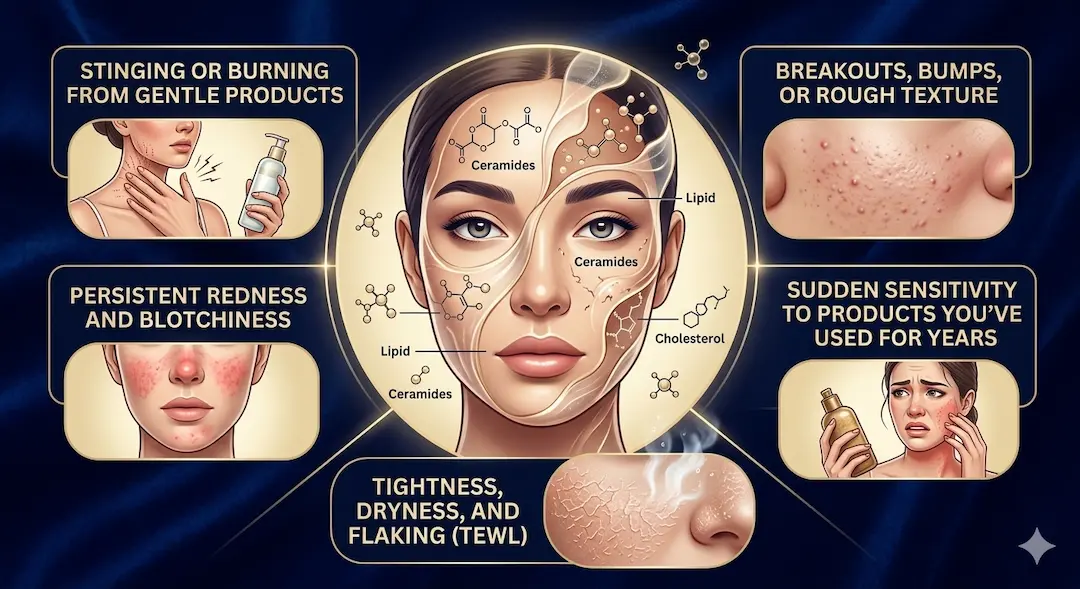
5 Signs of Skin Barrier Damage and How to Fix It Gently
Ever feel like your skin has suddenly turned against you—stinging at every serum, getting red for no reason, or feeling tight no matter how much cream you use? Those are classic SOS signals of a weakened skin barrier.
The good news? It’s not permanent. Your skin can bounce back. The secret is to “Go Gentle, Go Gentle, & Go Gentle“.
If you want to learn everything about “Skin Barrier” and “How to take care of it“, Read full length articles.
What is the Skin Barrier?
Your skin barrier is the outermost layer of your skin. It works like a protective shield to:
- Keep moisture inside the skin
- Block irritants, pollution, and microbes
- Reduce redness and sensitivity
5 Signs of Skin Barrier Damage
1. Stinging or Burning From Gentle Products
That familiar sting from a cleanser or moisturizer that once felt totally fine? That’s your skin waving a red flag. When the barrier thins, even the mildest formulas can suddenly feel fiery – especially around your nose and cheeks. It’s not that your skincare changed; your skin’s tolerance did.
If your skin starts “talking back,” it’s begging for calm – not more actives.
2. Persistent Redness and Blotchiness
When your skin stays flushed long after cleansing – or develops warm patches on your nose, chin, or cheeks – it means your natural armor has weakened. A fragile barrier struggles to handle tiny triggers like touch, temperature changes, or even a gentle breeze.
That stubborn redness isn’t just irritation; it’s a sign your skin barrier needs a hug, not a scrub.
3. Tightness, Dryness, and Flaking (TEWL)
If your skin feels tight moments after washing – even with moisturizer on – it’s losing water faster than it can hold it. This invisible water loss is called Transepidermal Water Loss (TEWL) and has nothing to do with sweat. Once it kicks in, dry patches, roughness, and dullness appear no matter how rich your cream is.
When hydration keeps vanishing, your barrier needs fixing first—moisturizer alone won’t cut it.
4. Sudden Sensitivity to Products You’ve Used for Years
If your trusty favorites now cause tingling, redness, or sudden breakouts, your skin isn’t being “picky”—it’s exhausted. Over‑exfoliating acids, too many actives, or harsh cleansers can slowly wear down barrier lipids and proteins, stripping away your built‑in protection.
When old favorites start to sting, it’s time to pause and rebuild – your skin’s memory foam needs recovery.
5. Breakouts, Bumps, or Rough Texture
When the barrier breaks, your skin loses its self‑control. Oil, bacteria, and dead cells get stuck instead of shedding smoothly, leading to small bumps, random breakouts, or an uneven texture that no filter can hide. The more you layer to “fix it,” the worse the chaos can get.
When your skin feels bumpy and off balance, simplifying your routine is the real glow secret.
What Causes Skin Barrier Damage
- External Factors such as Very Hot & Humid or Cold & Dry Weather, Pollution / Smog, UV exposure, and Artificial cooling / heating.
- Internal Factors such as Diet, hydration habits, lifestyle and daily mental stresses.
- Over enthusiastic, agressive Skincare Routine
The more sensitive your skin is, the easier it is for these factors to weaken your barrier. Read the article What Causes Skin Barrier Damage for better understanding.


How to Fix Skin Barrier Damage
Repairing the barrier isn’t about adding more aggressive treatments—it’s about simplifying and soothing.
Strip Back Your Routine
- Avoid Pause new actives and strong exfoliants. Focus on a minimal routine:
- Gentle cleanser
- Hydrating serum
- Barrier-supporting moisturizer
- Daytime SPF
- The goal is to calm inflammation, not chase perfection.
Choose Fragrance-Free or Very Low-Scent Formulas
For sensitive or reactive skin, fragrance-free is usually the safest choice—especially for leave-on products like serums, lotions, and oils. This reduces one of the most common triggers for irritation and barrier damage.
Look for Soothing, Barrier-Loving Ingredients
The ‘mortar’ inside your skin barrier is made up of ceramides, cholesterol, and free fatty acids. Using fragrance‑free formulas with ceramides, cholesterol, and fatty acids in a physiologic ratio (often in 3:1:1 Lipid Ratio) can help recover and reverse signs of barrier damage. Other natural products capable of providing long term support include :
- Aloe vera and vegetable glycerin (hydration)
- Shea butter and cocoa butter (nourishing emollients)
- Jojoba, sweet almond, and squalane (supportive oils)
- Oat, calendula, and chamomile extracts (soothing botanicals)
Be Gentle With Cleansing and Exfoliation
Use lukewarm—not hot—water, and limit exfoliation while your barrier heals. When you do exfoliate, choose a gentle method and follow with a rich, comforting moisturizer or body butter.
Moisturize Twice Daily (Face & Body)
Barrier repair needs consistency. Apply moisturizer morning and night, and don’t forget areas like the neck, chest, and hands. For the body, richer textures—like whipped butters and oils—help seal in moisture and protect fragile skin.
Frequently Asked Questions
What is Skin Barrier Damage?
Skin barrier damage (also called a “compromised” or “broken” skin barrier) means the outermost layer of your skin is not working as well as it should. Normally, this layer acts like a protective wall that keeps moisture in and irritants out. When it’s damaged, water escapes more easily and irritants can get in more easily, so your skin can feel:
– Dry, tight, rough, or flaky
– Red, itchy, or stinging
– More sensitive than usual (products that once felt fine now burn or irritate)
What Causes Skin Barrier Damage?
Skin barrier damage happens when the outer layer of your skin is weakened so it can’t hold in moisture or block irritants as well as it should. Common causes include:
Harsh or over‑washing – Using very foaming cleansers, washing too often, or wiping the skin too hard can strip away natural oils.
Over‑exfoliating – Using scrubs, acids, retinoids, or scrubs too often can thin the protective layer and make skin raw or sensitive.
Extreme weather and dry air – Cold, wind, low humidity, and indoor heating all increase water loss and dry out the barrier.
Strong ingredients and fragrances – High‑strength actives, alcohol‑based products, or strong fragrances (synthetic or essential oils) can irritate and inflame sensitive skin.
Sun exposure and pollutants – Too much UV light and air pollution can break down the skin’s protective lipids and increase sensitivity over time.
Genetics, aging, stress, lack of sleep, and certain skin conditions (like eczema or acne) can also make someone more prone to barrier damage.
How to Fix a Damaged Skin Barrier
Fixing a damaged skin barrier is less about “treating” and more about stopping what is hurting it and gently supporting recovery.
Simplify your routine – Stop harsh cleansers, scrubs, strong acids, retinoids, and anything that stings or burns. Stick to just a gentle cleanser, a hydrating serum (like hyaluronic acid or niacinamide), a barrier‑repair moisturizer, and daytime sunscreen.
Use barrier‑supporting ingredients – Choose fragrance‑free products with ceramides, cholesterol, and fatty acids (often in a 3:1:1–type ratio) plus humectants such as glycerin or hyaluronic acid. These fill the “gaps” in the barrier and help it retain moisture.
Be gentle with cleansing and water – Wash with lukewarm water, use a gentle, pH‑balanced cleanser, and pat dry—don’t rub. Avoid very hot showers or face‑washing with hot water, which strip natural oils.
Moisturize consistently – Apply a rich, fragrance‑free moisturizer at least twice a day, especially on damp skin, to lock in water. For very dry or cracked areas, a thin layer of petrolatum‑type ointment at night can speed healing.
Give it time – With a calm, consistent routine, most mild to moderate barrier damage improves in about 2–8 weeks, though very sensitive or severely damaged skin can take longer.
Citations
Cleveland Clinic. “How To Tell If Your Skin Barrier Is Damaged.” Cleveland Clinic, 2022. https://health.clevelandclinic.org/skin-barrier.
Rajkumar, J., et al. “The Skin Barrier and Moisturization: Function, Disruption, and Repair.” Skin Pharmacology and Physiology 36, no. 4 (2023): 174–185. https://www.karger.com/spp/article/36/4/174/863006/The-Skin-Barrier-and-Moisturization-Function
Elias, P. M., et al. “Clinical Perspective: Moisturizers vs. Barrier Repair in the Management of Atopic Dermatitis.” Journal of Drugs in Dermatology 17, no. 8 (2018): 855–858. https://pmc.ncbi.nlm.nih.gov/articles/PMC6289688/
Leave a Reply